Fernández Martínez, P., Coco, V., Gkougkousis, E.-L., Halvorsen Mahlum, M., Petrogiannis, G., Pellegrini, G., Rodríguez Rodríguez, E. (2023). Tracking the Time: Measurements towards the characterization of a 3D pixel in terms of time resolution and Landau contribution evaluation. Nuclear Instruments and Methods in Physics Research Section A: Accelerators, Spectrometers, Detectors and Associated Equipment, 1047, 167788. DOI: https://doi.org/10.1016/j.nima.2022.167788
Abstract
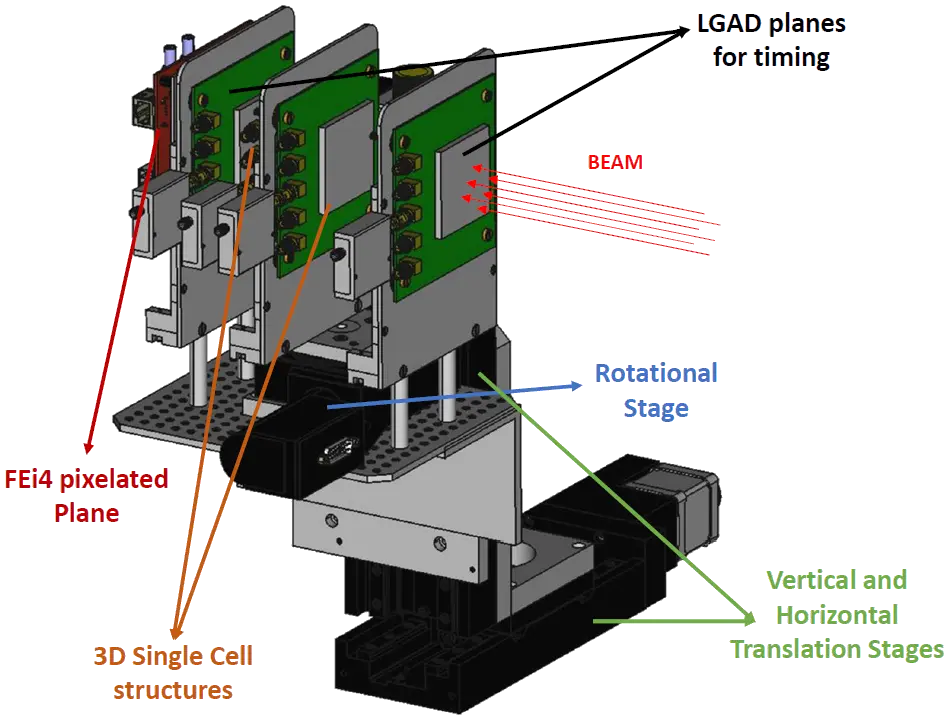
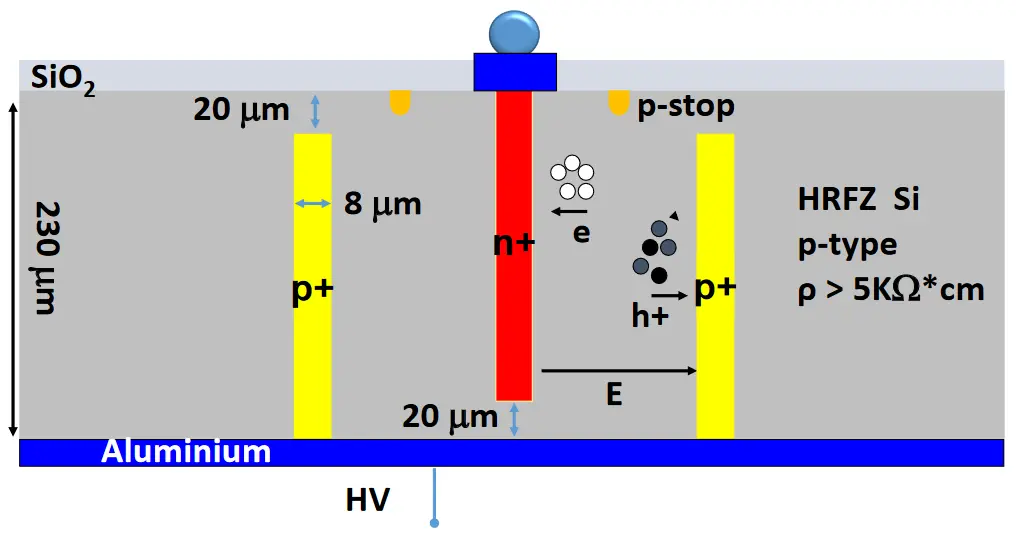
The proven potential of 3D geometries at higher than 10^16 n·eq/cm^2 radiation fluences, combined with a small cell approach, makes them an excellent choice for a combined precision timing tracker. This study presents preliminary results on the timing resolution of a single 50×50μm^2 3D pixel cell through charge collection measurements with discrete electronics in a laboratory setup. In a test-beam campaign with 160 GeV SPS pions, a detailed timing, field, and efficiency map is presented using a multi-plane timing telescope with an integrated pixelated matrix. Another testbeam campaign was completed with the EUDET telescope to study field uniformity, Landau contribution, collected charge, and incidence angles of +/−12°, achieving a preliminary 5μm spatial resolution through MIMOSA CMOS tracking at CERN SPS pion beams.