
Project Overview
| Role: Project Lead | Duration: 2022-Present | Organization: CERN/Nikhef |
The Challenge
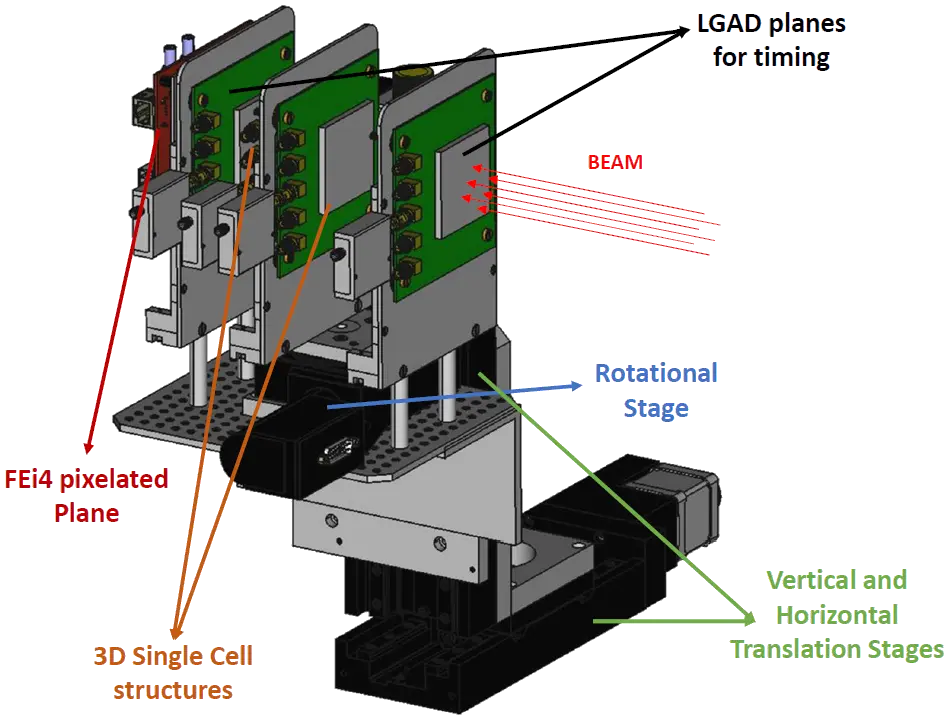
Design and build a particle tracking telescope capable of sub-100 picosecond timing resolution and micrometre-level spatial precision for validating next-generation detectors at CERN’s SPS beam facility. No existing system combined both capabilities.
My Contribution
- Led a cross-institutional team across CERN and Nikhef
- Designed 8-plane detector configuration mixing thin (100 μm) sensors for timing and thick (300 μm) sensors for spatial resolution
- Built calibration procedures: per-pixel VCO frequency correction, four-parameter timewalk model, and intra-run drift subtraction
- Developed Python/C++ analysis pipeline processing TB-scale datasets (185,000+ grid jobs for timing characterization)
- Implemented CO₂ cooling system achieving stable -30°C operation
- Coordinated 12+ test beam campaigns at CERN SPS (2021-2025), serving as campaign coordinator for 2
Technical Stack
Python ROOT C++ Git Data Analysis Hardware Integration Cryogenics
Results
- 92 ± 5 ps track timing resolution, a 4× improvement over the Timepix3 predecessor (350 ps)
- 2.3 ± 0.1 μm pointing resolution at the device-under-test position
- 98-99% cluster efficiency on thin planes, sustaining 2×10⁶ particles/s with <1% efficiency loss
- The only beam telescope combining micrometre pointing with sub-100 ps track timing
- Results presented at the Hiroshima Symposium (HSTD13) and adopted for characterizing LGAD and 3D sensors in the 20-40 ps regime
Industry Relevance
This project demonstrates skills directly applicable to:
- Project Management: Coordinating international teams and resources
- System Integration: Combining hardware, software, and infrastructure
- Data Engineering: Processing TB-scale datasets with quick turnaround
- Problem Solving: Optimizing complex multi-variable systems