
Project Overview
| Role: PhD Researcher & Electronics Developer | Duration: 2019-2024 | Scale: Multi-million EUR international project |
The Challenge
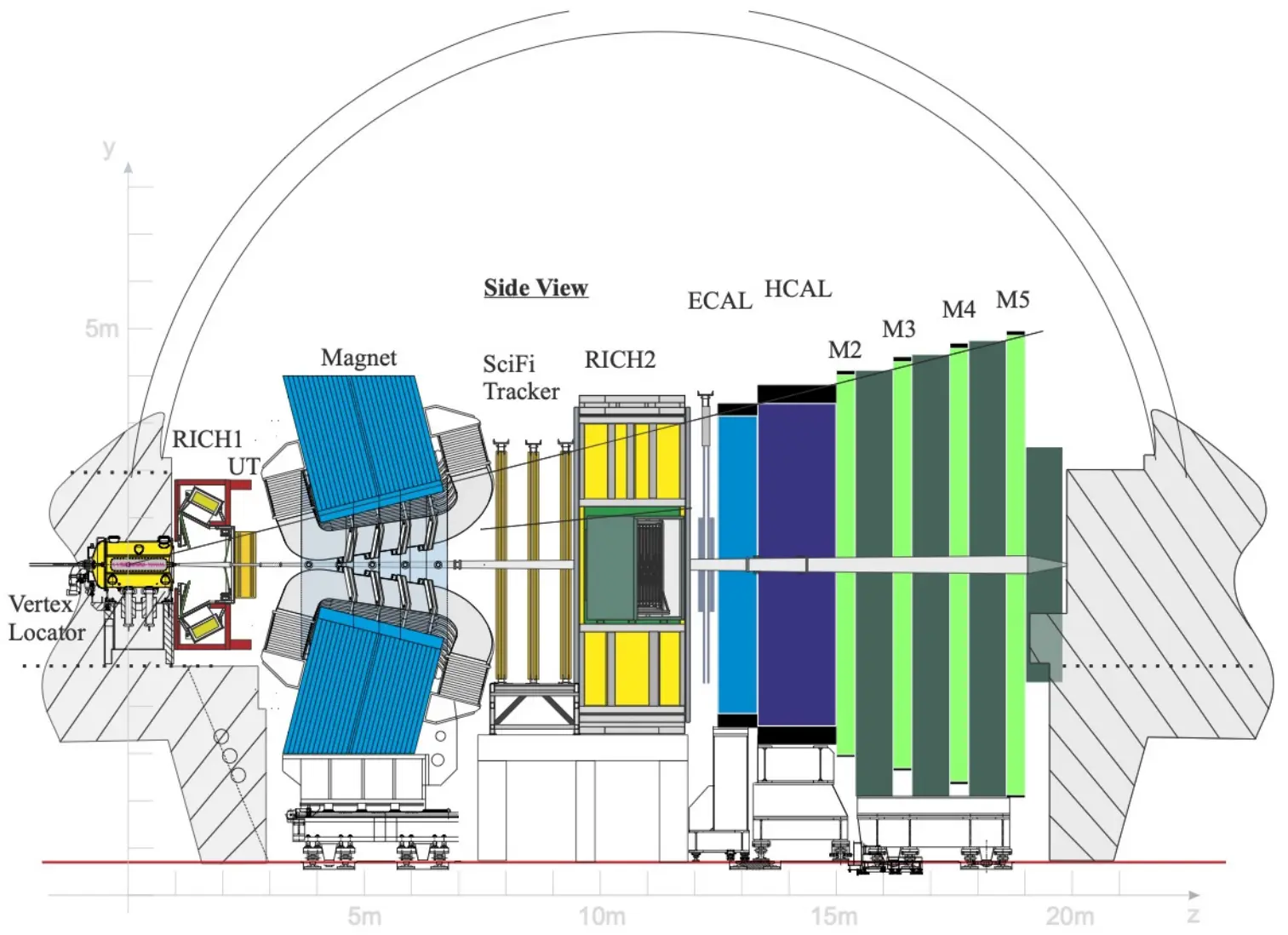
Upgrade the LHCb vertex detector (VELO) to handle 5× higher data rates and operate in an extreme radiation environment. The full system: 52 modules, 624 VeloPix ASICs, 41 million pixels, approaching within 5.1 mm of the LHC beam.
My Contribution
- Designed and characterized high-speed data transmission lines (8 channels at 5 Gbps each, 40 Gbps total throughput)
- Developed high-voltage flat cables rated for 1000V operation, balancing signal integrity against radiation and space constraints
- Performed quality assurance testing on 1000+ electronic components across 3 labs (CERN, Nikhef, IGFAE)
- Planned and executed adhesive irradiation campaigns at up to 600 Mrad, achieving 5% dose uniformity
- Developed GWT-based threshold equalization system, eliminating crosstalk and shutter-induced noise from pixel characterization
- Participated in detector commissioning and installation in the LHCb cavern
Technical Stack
Electronics Design LabVIEW VHDL Quality Assurance Python ROOT
Results
- €20M+ detector system launched and operational since 2023 with zero critical defects
- Data transmission reliability >99.9% across all 8 channels
- All components passed radiation hardness requirements (tested up to 600 Mrad)
- Now taking collision data at the world’s largest particle accelerator, contributing to LHCb’s flavour physics programme
Industry Relevance
Skills directly applicable to:
- Electronics R&D: High-speed signal design and characterization
- Quality Engineering: Systematic testing and validation procedures
- Large-scale Projects: Working within complex organizational structures
- Technical Documentation: Creating procedures for international teams